
Beyo Global 2025 Round-up
I’ve learned that not every year should be measured by how much happens. Some years are about forward motion that’s easy to see. Others are about quieter decisions that change how you move altogether.
2025 was the latter.
From the outside, it may look like a quieter year with fewer announcements, less visible expansion and less emphasis on scale for scale’s sake. From the inside, it was one of the most decisive.
This was a year of structural choices: About the level at which I work, the kinds of problems I engage with and the role I play inside organisations. I chose depth over volume, judgement over speed and foundations over performative momentum.
Many of the decisions made this year won’t show their full impact immediately. But they shape what becomes possible next and what no longer makes sense to pursue.
It’s the same on a personal level.
2025 grounded me in a way I didn’t fully anticipate, like starting a meaningful, safe and healthy relationship, investing more deliberately in close friendships and building rhythms that genuinely support the way I work.
More movement (e.g. weight exercises, yoga). Healthier diet. Better sleep. These led to fewer migraines, more clarity and more steadiness.
That steadiness shaped my work.
Teaching culture early (and why it matters)
In January, I gave a lecture at Aalen University in Germany to a room of 80+ students aged 17 - 18 years old. Most of them were new to UX and just beginning to encounter cultures beyond their own.
Instead of starting with tools or processes, I started with awareness.
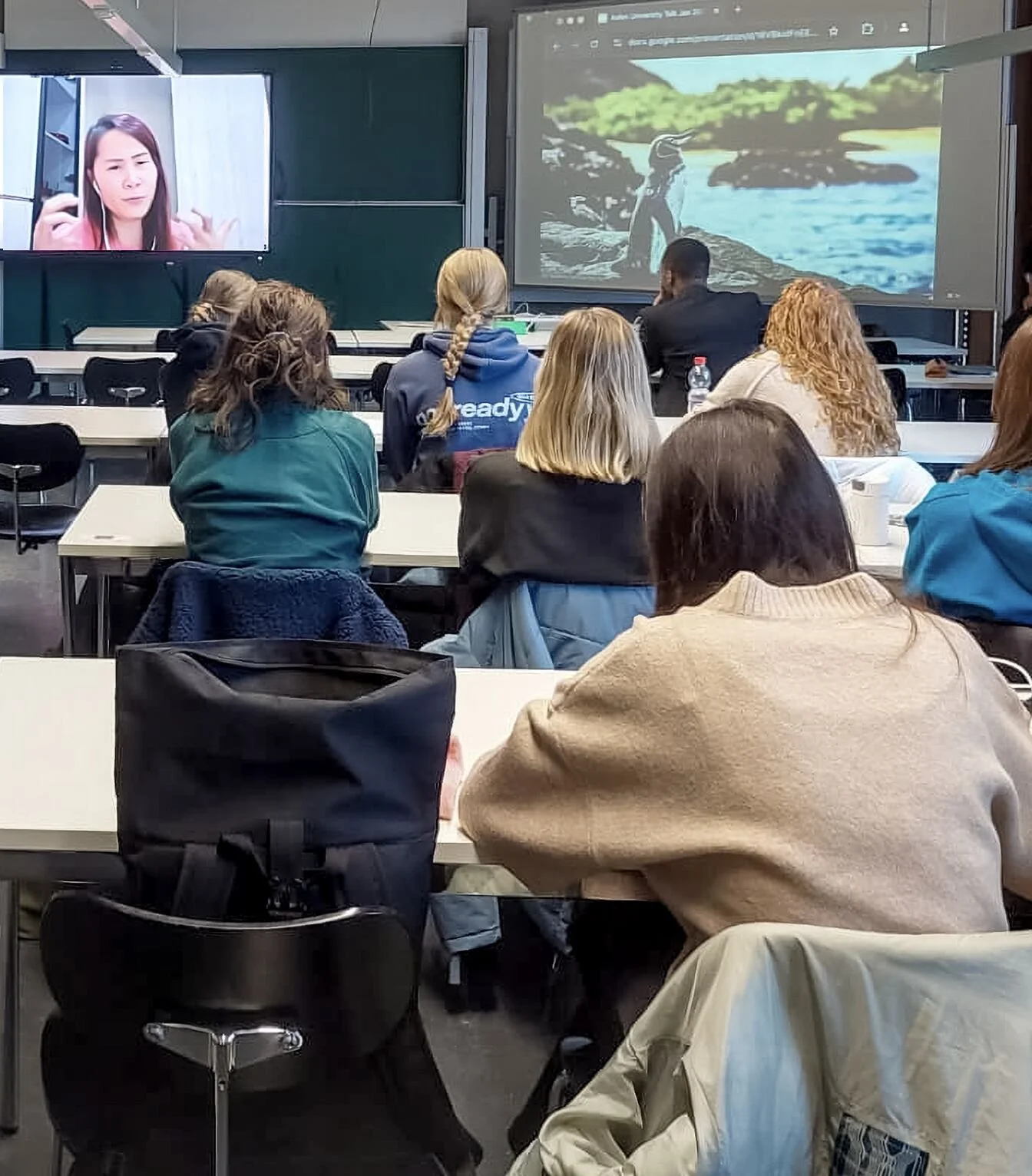
Chui Chui Tan - Guest lecturing at Aalen University, Germany
We explored:
How culture shows up in the things they already care about: Cosmetics, games, music, interfaces they use every day
How values, mentalities and social norms quietly shape behaviour
Why cultural understanding isn’t a soft skill, but a lifelong capability that affects products, businesses and societies
My goal wasn’t to overwhelm them, but to open a door.
The lecturer, who have already been incorporated my framework and materials from my talks and book (Research for Global Growth) in their teaching, later told me that several students shared how the lecture has also helped them better understand their migrant parents, or navigate relationships with partners from different cultural backgrounds.
That mattered to me. Not just because it impacted their learning and their future professionals, but because it reached their lives.
A few months later, I learned that new students who hadn’t even attended the lecture were asking if “the lady with the same first name twice” (aka Chui Chui) would be coming back.
It made me smile and I was pleased because that kind of impact doesn’t show up in metrics dashboards. But it’s the kind that lasts.
Throughout the year, I continued speaking and teaching across Europe and Asia, from PM Huddle in Kuala Lumpur (my first talk in Malaysia and Southeast Asia, and close to home) to Rosenfeld’s Advancing Research, UXLisbon, Fusecon in KL, Productized in Lisbon and Product Management Festival in Zurich.
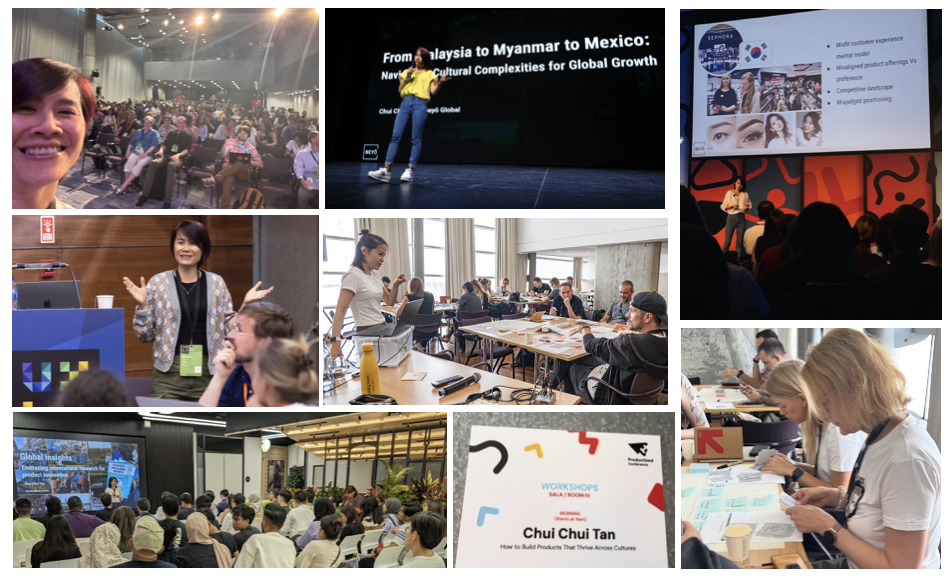
Chui Chui Tan - Speaking and running workshops at various conferences in 2026
At UXLisbon, I formally introduced something I’ve been quietly developing quietly over time: My Culture Activation Toolkit.
It’s a practical framework built around 28 cultural aspects that helps teams identify which cultural factors actually matter for their product, market and challenge rather than defaulting to stereotypes or generic country profiles. It treats culture not as a checklist, but as a strategic lens.
Seeing designers, researchers, PMs, data scientists and growth leaders use it together, surfacing blind spots, challenging each other’s assumptions and aligning on priorities in real time was one of the most satisfying moments of the year. It reinforced something I’ve long believed:
Culture becomes powerful when it’s made actionable, not abstract.
Research as strategic intervention, not validation theatre
A large part of 2025 was spent deep inside complex, high-stakes research. They are the kind where getting it wrong costs time, trust and long-term growth.
I continued working closely with Spotify across multiple markets and problem spaces.
Early in the year, I travelled to Colombia with their Growth team to explore why Premium growth had slowed despite strong brand love and awareness. We uncovered how free access, cultural attitudes toward spending on digital vs. physical experiences and misconceptions about pricing shape conversion behaviour. I found my time in Bogotá and Medellín deeply fascinating. I’m keen to return to Colombia to continue learning from what I only began to discover and observe.
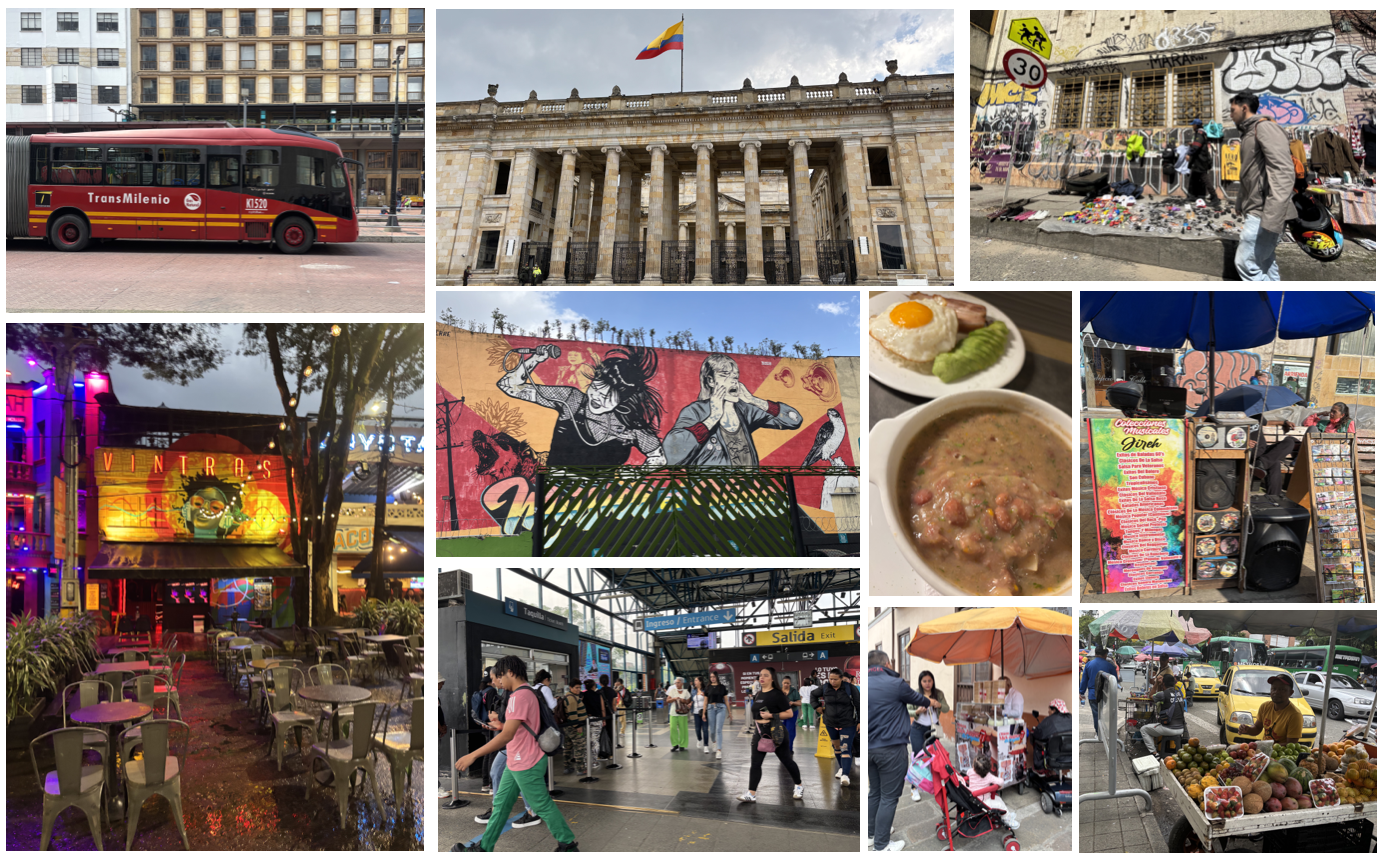
Bogotá & Medellín, Colombia (2025)
In Germany, I worked with the partnerships and culture marketing team to establish a Gen Z baseline around Spotify’s cultural role in Deutschrap, ahead of a major campaign launched at the end of October across the whole November 2025, looking beyond usage to questions of authenticity, cultural credibility, trust in curation and the tension between supporting culture and being perceived as ‘too commercial’.
Spotify also launched its Platinum proposition in five selected markets. It was one of their high-profile initiatives where getting it right was critical. I supported the validation and refinement of the proposition and its market expression across India, Indonesia, Saudi Arabia and South Africa. We examined how luxury, status, personalisation and value are understood very differently depending on cultural context, even when the product is the same.
In Italy, I worked with Spotify on Managed Accounts for Gen Alpha, navigating parental control, autonomy, safety and trust in ways that respect both children’s independence and parents’ values. Listening to children aged 8 - 12 talk about how much agency they believe they should have and observing their dynamics with parents was particularly revealing.
In early December 2025, Spotify piloted a QR-code re-verification flow in selected markets. It was important for Spotify to find the right balance between ensuring the experience is intuitive, fair and reliable, while minimising friction and avoiding an accusatory tone, especially to legitimate households. Canada was chosen as a pre-launch testing ground. We learned that the biggest risks weren’t technical, but emotional: Tone, perceived fairness and how ‘rules’ are communicated to real families.
Toward the end of the year, I worked with Spotify to explore how joy, confidence, karaoke culture and social rituals differ between markets like Indonesia and the UK, and what makes a singalong experience feel playful rather than performative.
Across all of this work, the goal was never about producing insights for their own sake.
It was about protecting teams from false confidence, from assuming that scale equals understanding or that one successful market can stand in for many. It’s about helping them make decisions that respect cultural reality rather than override it.
Product-market fit across cultures
Another important strand of work in 2025 focused on product–market fit across markets that appear similar on the surface, but differ significantly once you look more closely.
Following the acquisition of a UK-based fintech by a US financial services company, the team wanted to understand whether (and how) their existing propositions could translate meaningfully into the UK context.
Despite shared language and financial infrastructure, the cultural realities around money, investing, risk, long-term planning and trust differ in important ways between the two markets.
I was brought in to help explore what credible product–market fit could look like in the UK, including proposition, positioning, hero messaging, value pillars and feature priorities, grounded in local financial culture and ecosystem.
The work was structured in phases:
An explorative survey to map attitudes, behaviours and mental models around money, investing, ISAs and micro-investing
In-depth one-to-one conversations to unpack motivations, anxieties, trust signals and decision-making patterns
We completed the first two phases in 2025. The insights revealed both expected and less obvious differences, not just in behaviour, but in how people relate to concepts like ‘investing for the future’ and financial legitimacy.
The work continues into 2026, focusing on translating those insights into sharper proposition decisions and validation to ensure cultural fit rather than surface-level localisation.
Advisory work and building capability, not dependency
Alongside project work, I stepped further into advisory roles.
With Storytel (one of the world's largest audiobook and e-book streaming services), this took two distinct forms in 2025.
The first was strategic: Acting as an expert reviewer and advisor on a new business initiative. My role was to assess the underlying business case, challenge assumptions and provide input that helped the team clarify positioning, value and long-term viability before seeking internal sign-off.
Once that direction was approved, the work shifted.
The second phase involved speaking directly with authors across Nordic markets to validate whether the proposed direction genuinely addressed their realities, needs and constraints. These conversations surfaced tensions around visibility, humility, self-promotion, data opacity and the emotional labour of marketing oneself. All deeply shaped by cultural context.
This wasn’t about feature feedback. It was about ensuring that alignment between what was being built and how authors actually live and work.
In parallel, I also worked with Storytel in building research capability, diagnosing why research wasn’t landing, where collaboration broke down and how to design research operations that genuinely support strategy across product, tech and business.
2025 focused on understanding, frameworks and foundations.
2026 will focus on execution and refinement.
I’m looking forward to continuing the work with the Storytel team.
With Inside Travel Group, I supported their redesign of their InsideAsia website, coaching teams on how to plan, run and integrate research across the UK, US and Australia. The goal wasn’t to outsource thinking, but to help teams build confidence in making culturally informed decisions themselves.
This kind of work is quieter than launches. But it’s the work that changes how organisations operate long after I’ve stepped away.
AI, culture and what’s missing
One of the biggest undercurrents of 2025 didn’t come from a client brief.
It came from observing how quickly AI is being woven into decision-making, product development and strategy but often with an unspoken assumption that scale equals understanding.
Recognising how central AI is becoming to our lives and our work, I also became increasingly concerned about what’s missing:
Cultural coverage that is shallow, uneven or Western-centred
Pattern recognition without cultural context
Confidence without accountability
So alongside client work, I began deliberately exploring how an AI-powered approach to culturalisation might look - one that goes beyond country labels or training data shortcuts.
This exploration (tentatively called MarketIQ) is still being shaped with care. It’s not about automating culture. It’s about supporting better questions, better scoping and better judgement when humans and AI work together.
More on this in 2026.
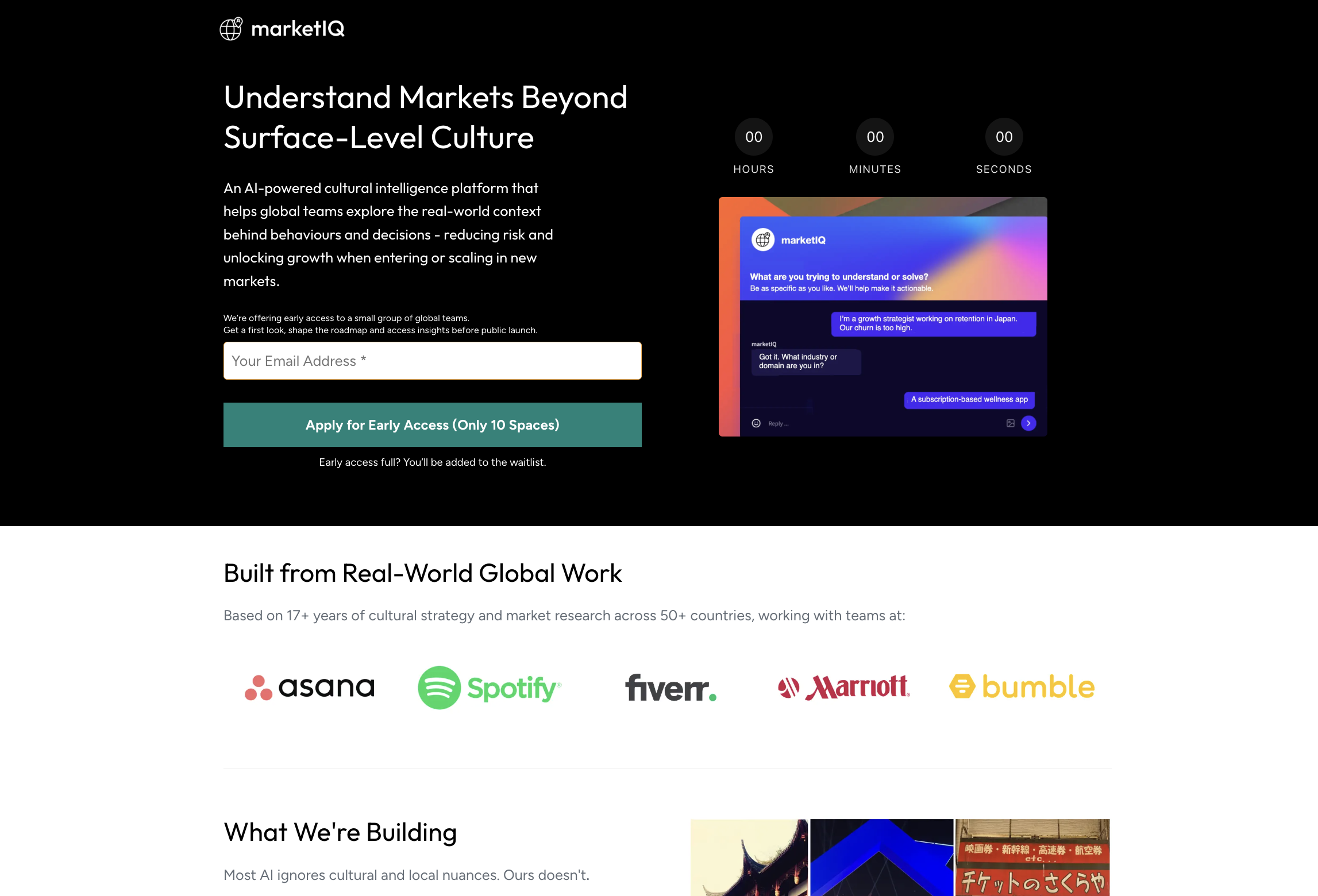
AI-powered cultural intelligence platform - by Chui Chui Tan
Conversations, not broadcasts
Throughout the year, I joined conversations rather than chasing visibility by appearing on podcasts like Product Voices, UX Research Geeks, The Negotiation Podcast, Productized, Navigating Service Design and others.
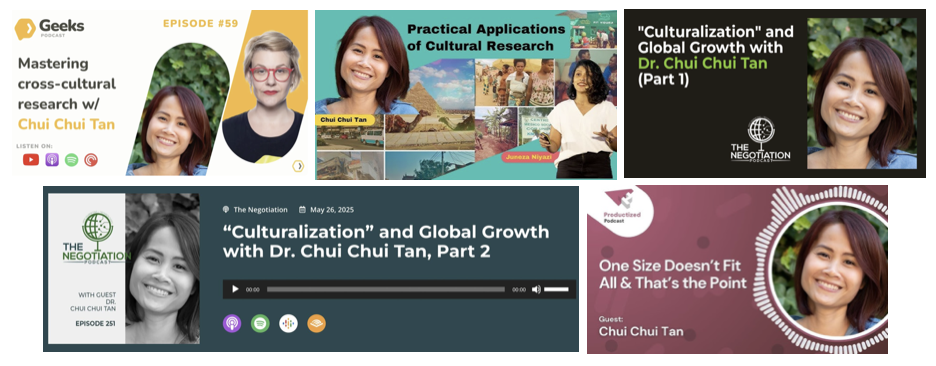
Chui Chui’s podcasts appearance in 2025
These weren’t about trend discussions. They were conversations about judgement, trade-offs and what it really means to work across cultures when the stakes are real.
I also continued building my own platforms by experimenting with video and YouTube to share ideas in a more accessible way.
Looking ahead
If 2024 was about recalibration, 2025 was about alignment.
Between how I live, how I work and the level at which I contribute.
I’m increasingly focused on problems at the intersection of culture, strategy and long-term value. I very much focus on working with teams who want thinking partners, not just deliverables.
Sometimes impact looks like a successful launch.
Sometimes it looks like a student remembering ‘the lady with the same first name twice’.
Sometimes it looks like a business avoiding a costly mistake before it happens.
Real impact doesn’t need algorithms.
It comes from meaningful connection, thoughtful decisions and the patience to do the work properly.
THANK YOU!
As always, thank you to the clients, collaborators, students and friends who made this year what it was.